
 (888) 229-7989
 Client Portal

How Long Does Adderall Stay in Your System? Detection Windows and Test Factors


Key Points
- Adderall is a mixture of amphetamine salts commonly prescribed for treating attention-deficit hyperactivity disorder (ADHD)
- Many urine tests can identify Adderall for several days after the user last took the medication, which is far beyond how long its effects are felt.
- Adderall XR (extended release) delivers medication into the body over a longer period than Adderall IR (immediate release). However, both versions of the drug can give a positive amphetamine reading on a urine drug test.
- There are many factors that can affect how long a substance is detectable, including dosage amounts, dose frequency, pH level of the urine, kidney function, body composition, metabolic rates, and what kind of test was used.
If you’re taking Adderall regularly, you may not think much about what happens after your last dose. But if you’ve just upped your dose or have just stopped taking the medication and are worried because you have a drug test coming up, a simple question can suddenly become important: how long does Adderall actually stay in your body?
The answer isn’t always as straightforward as you might expect. Here’s what to know about Adderall after you stop taking it and how long the most common forms of tests can detect it.
How Long Can Adderall Be Detected in the System?
Adderall is a central nervous system stimulant medication made from mixed amphetamine salts, typically prescribed to treat ADHD symptoms and narcolepsy.[1] It is the amphetamine that shows up on standard drug tests; the tests do not detect Adderall itself, meaning a standard amphetamine test cannot determine whether someone was taking Adderall, Vyvanse, or another source of amphetamine.
Many people take Adderall, so even though it is a controlled substance, testing positive for amphetamines shouldn’t necessarily be a cause for concern if you can provide a legitimate Adderall prescription; it can raise questions in someone who does not have a prescription or is taking an illicit substance.
Like most things associated with body chemistry, a number of factors affect how long Adderall and amphetamine detection windows vary, and exactly how long the drug remains detectable can differ from person to person, including:[2]
- Dose
- Metabolism
- Time since last dose
- Frequency of use
- Urine pH
- Hydration status
- Kidney function
- Test sensitivity
- Cutoff value
- Whether confirmatory testing is done
- Other medications potentially interfering with screening tests
- Overall health of the person being tested
The detection window also depends on what type of Adderall formula you take, whether it’s immediate-release Adderall or the extended-release version, Adderall XR. Below, you’ll see how detection works across urine, blood, saliva, and hair testing, how Adderall XR and Adderall IR differ, what can cause false positives, and when it may be time to look for help for dependency or misuse.
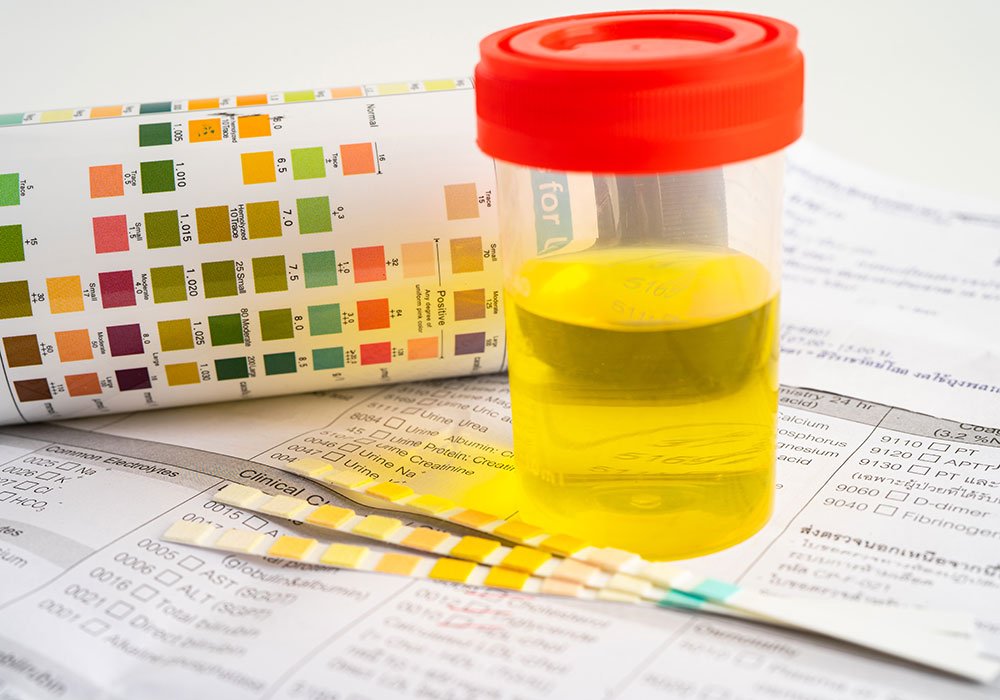
How Long Will Adderall Show Up on a Urine Test?
Urine drug testing is one of the most common forms of testing to determine the presence of amphetamine. These tests look for amphetamine (or metabolites) that are present in the urine after consumption.[3]
Urine testing can detect amphetamine type stimulants 3 to 5 days after last ingestion, though detection windows can vary person to person. Urine pH can also affect how quickly amphetamine is eliminated. Acidic urine increases amphetamine excretion, while alkaline urine slows renal elimination and may prolong the time it remains detectable.
How Long Is Adderall Detectable in Blood?
Blood tests are typically used for recent exposure. They are less common than urine testing for routine substance use screening but may be used in medical settings or emergency situations.
Due to variations in half-life among patients, blood detection times depend greatly on the timing and dose of amphetamine taken, but can range from 7 to 34 hours.[4]
How Long Is Adderall Detected in Saliva?
Saliva testing, also known as oral fluid testing, generally indicates more recent drug exposure than urine tests and are sometimes used because collection is less invasive than with blood or urine.
A clinical trial investigating therapeutic doses of stimulants reported that oral fluid samples containing amphetamine yielded median detection times ranging from approximately 67 to 69 hours post-dosing (depending on either lisdexamfetamine or dexamphetamine).[5]
How Long Is Adderall Detectable in Hair?
Hair testing provides one of the longest detection times associated with any drug test type, though it cannot establish evidence of recent use.
Hair drug testing can provide detection capabilities of up to ninety days.[6] However, results can be complex due to a number of variables that influence findings, including length of hair specimen submitted, rate of hair growth, cosmetic treatments applied to hair before sampling, collection techniques used, and lab standards.
Hair testing is occasionally used in workplace or forensic settings; however, it is rarely used in medical settings as a diagnostic tool.
Adderall Detection Periods at a Glance
Detection Periods by Test Type
| Test type | Approximate detection period |
| Urine | 1–5 days |
| Blood | Short period; generally detects recent use |
| Saliva | Up to 2–3 days |
| Hair | Up to 90 days |
What Is the Half-Life of Adderall?
Half-life plays a big role in how long Adderall can be detected. Even though its effects last up to eight to twelve hours, it can stay in the body much longer. Half-life is the period necessary for the concentration of an active compound in the bloodstream to decrease by 50%.
Due to varying concentrations of different salt compounds contained in its formula, Adderall’s half-life can vary significantly based on a number of factors including age, body weight, urine pH, and others.
The average elimination half-life for d-amphetamine is approximately 9.77 to 11 hours, compared with a longer range for l-amphetamine isomers.[7] It takes multiple half-lives before an active compound is mostly removed from a person’s body.
The process is different for everyone, which explains why detection times can vary so widely from person to person. It’s also important to remember that “mostly removed” doesn’t mean undetectable. Sensitive tests can measure the drug’s presence or its metabolite levels long after the drug wears off.
Can Other Medications Cause a Positive Amphetamine Screen?
There are prescription medications (and illicit amphetamines) that may cause a false positive result for amphetamine.
Some examples include:
- Bupropion
- Chlorpromazine
- Desipramine
- Fluoxetine
- Labetalol
- Promethazine
- Ranitidine
- Pseudoephedrine
- Trazodone
- And many other prescription medications[8]
Do not stop your prescribed medication due to a false positive test result. Instead, provide accurate information about your currently prescribed medication and ask if confirmatory testing is available.
Adderall Abuse, Physical Dependence, and Withdrawal
If you are researching this content because you are worried about testing positive for amphetamines for whatever reason, this may point to a larger problem. Prescribed Adderall is helpful when used correctly. However, misuse of this medication can be dangerous.
Misuse of Adderall includes:
- Using it without a prescription
- Taking more than prescribed
- Taking it more frequently than directed
- Crushing or snorting pills
- Using it to avoid feeling tired or to lose weight
- Using it to feel euphoric
- Experiencing withdrawal symptoms if you stop or reduce your dose
- Mixing it with alcohol or other substances
- Taking a friend’s prescription
If you meet the above criteria or you simply feel that your Adderall use is becoming something you can no longer control, whether or not an upcoming drug test is involved, then professional help would be a wise next step.
Recovery From Adderall Addiction at SOBA NJ
If you are looking for answers on how long Adderall remains detectable within your system because you believe you have developed a dependency on the drug through misuse or fear of losing control over your use, you don’t have to go through it alone.
SOBA New Jersey offers addiction treatment and mental health services for people struggling with substance use disorders and co-occurring mental health conditions, including ADHD.
Whether you are taking Adderall or another prescription stimulant medication and finding it difficult to manage, help is available, and it can start now. Reach out today so we can help you learn more about the available treatment options and start the process toward a safer and healthier tomorrow.
Frequently Asked Questions About Adderall Detection Periods
Adderall can be detected from a few hours to days after the most recent intake; however, the length of time depends on the test being used. A urine test can identify amphetamine for 1 to 5 days. However, this timeframe can vary greatly based upon many different factors, including test method and laboratory, plus individual factors like weight, age, and how fast your body processes Adderall.
Adderall may remain detectable in the urine from 3 to 5 days after taking it. Some laboratory references indicate a slightly narrower range dependent upon the test’s cutoff value and the person’s use patterns.
Blood tests are generally better at detecting more current drug exposure than urine tests. The exact amount of time that Adderall is detectable in a person’s blood will depend upon several factors such as the dose taken, the half-life of the medication (e.g., when levels reach 50% of their maximum), the laboratory methods used by the testing facility, and a person’s own rate of metabolizing the drug.
Adderall XR slowly releases amphetamine into the body throughout the course of a typical day, whereas Adderall IR typically provides a rapid onset of effect with a relatively short duration. Although it may seem like Adderall XR produces effects for a longer duration of time, both types of medication can be present in a urine sample for a number of days depending on the testing facility and test method used.
There are numerous variables that impact the detection times for Adderall. These include dose size, frequency of dosing, pH level of urine, kidney function, body weight, hydration, test method, test cutoff values, and whether you take immediate release or extended release formulations.
Yes. Prescription Adderall can produce a true positive amphetamine result. Tell the testing program or medical review officer about valid prescriptions as instructed.
There Is A Better Way To Live. It’s Time To Get The Help You Deserve.
Take the first step in getting your life back. Speak with our admissions team today.
[1] [7] U.S. National Library of Medicine. (2024). Adderall, dextroamphetamine saccharate, amphetamine aspartate, dextroamphetamine sulfate, and amphetamine sulfate tablet. DailyMed. https://dailymed.nlm.nih.gov/dailymed/drugInfo.cfm?setid=f22635fe-821d-4cde-aa12-419f8b53db81
[2] [4] ARUP Laboratories. (2026). Drug analytes detected in plasma and urine. https://www.aruplab.com/files/resources/pain-management/DrugAnalytesPlasmaUrine.pdf
[3] Mayo Clinic Laboratories. (n.d.). Drug testing: Amphetamine-type stimulants. https://backend.mayocliniclabs.com/test-info/drug-book/amphetamine.html
[5] Reisfield, G. M., et al. (2025). Drug detection in oral fluid and urine after single therapeutic doses of dexamphetamine, lisdexamfetamine, and methylphenidate in healthy volunteers. Journal of Analytical Toxicology. https://pmc.ncbi.nlm.nih.gov/articles/PMC12217515/
[6] Labcorp. (n.d.). Hair follicle drug testing. https://www.labcorp.com/organizations/capabilities/employee-testing-wellness/pre-employment-drug-testing/hair-drug-testing
[8] Substance Abuse and Mental Health Services Administration. (2021). Urine or oral fluid drug testing. In Medications for opioid use disorder. National Center for Biotechnology Information. https://www.ncbi.nlm.nih.gov/books/NBK574912/table/p2.t4/