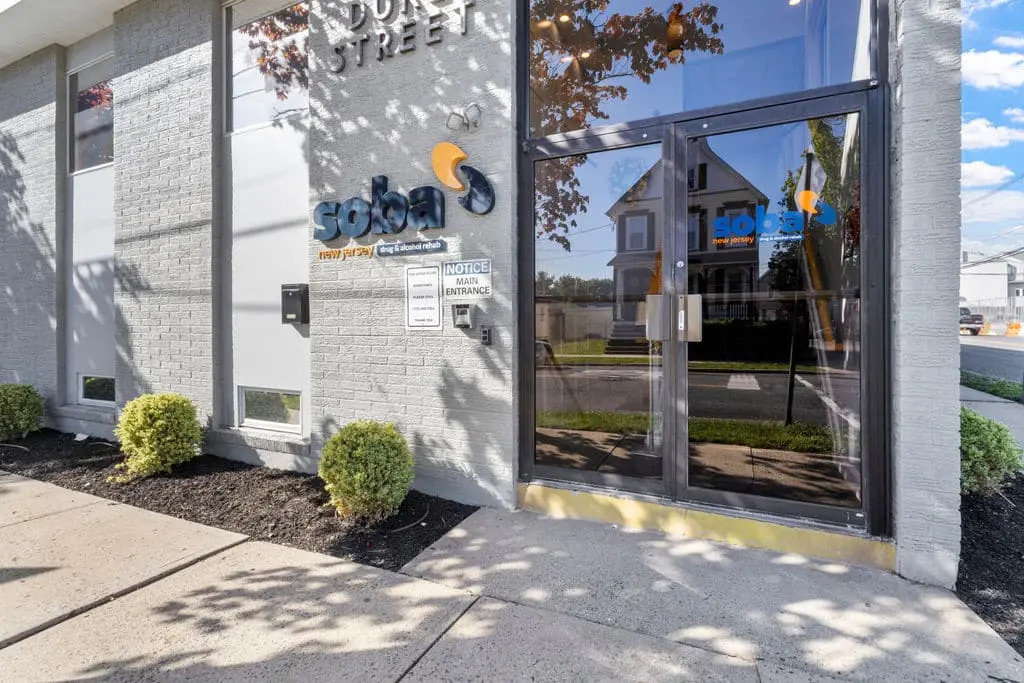
Building exterior with soba new jersey drug & alcohol rehab logo on gray brick wall, glass door entrance.

Our Addiction Levels of Care at SOBA New Jersey

No two recovery journeys are alike. We match each person with the level of care that best supports lasting recovery.

No two recovery journeys are alike. We match each person with the level of care that best supports lasting recovery.

Person in white shirt with clipboard sitting, another in black typing on laptop. Person sitting in beige outfit, appearing thoughtful, holding hands to mouth in a modern room.

Addiction Treatment That Evolves With Your Recovery

Recovery from addiction is not a one-size-fits-all experience. Some people need medically supervised detox before beginning therapy. Many others start with residential treatment or a form of outpatient treatment while living in sober living as they work to build their daily lives again. This is why SOBA New Jersey offers a complete continuum of care to provide clients with options for all stages of the recovery process.

Our clinical team develops a personalized treatment plan based on your specific symptoms, substance use history, mental health needs, social network, and personal recovery goals. This lets us match each person to the most suitable level of treatment, then adjust that level when their needs change using our three-phase model.

01

Phase 1: Stabilization

This phase addresses immediate safety issues related to substance use or withdrawal. During this phase, clients may undergo medical detox if withdrawal symptoms would make it hard to begin more meaningful therapeutic work.

02

Phase 2: Intensive Treatment

This phase involves the clinical aspects of recovery. Clients may remain in residential treatment, PHP, or IOP and address substance use disorders, mental health issues, trauma, family dynamics, relapse risks, and day-to-day coping skills.

03

Phase 3: Continued Care and Community Reintegration

 This final phase involves helping the client settle back into daily life while providing support for continued recovery. Outpatient treatment, sober living, telemedicine, alumni support, and relapse prevention planning can help the client hold onto their gains while rebuilding independence.


Levels of care

Medical Detox

Medical detox is often the first stage of treatment for those who have developed a physical dependence on alcohol, opioids, benzodiazepines, or other substances.[1] During detox, the body clears the substances while medical professionals monitor and treat withdrawal symptoms. At SOBA New Jersey, detox takes place under the direct supervision of clinical staff in a safe and comfortable environment, day and night.

Inpatient Residential

Residential inpatient addiction treatment provides a structured environment where clients can step away from potential triggers, build new routines, and focus fully on their recovery.[2] Inpatient residential addiction treatment is generally the next step for many clients after detox, because a safe and supportive environment is needed to begin building long-term recovery.

Partial Hospitalization Program

Partial hospitalization programs, also referred to as PHP, provide a high degree of clinical support without continuous inpatient supervision.[3] Partial hospitalization services are ideal for clients who need structured care but do not need around-the-clock monitoring.

PHPs are often used as a step-down from detox or residential treatment; however, some clients may start care in a PHP if their symptoms and home environment make it the most appropriate option. Services available in a PHP may include therapy, case management, relapse prevention planning, and support for mental health issues tied to substance use disorders. Partial hospitalization programs offer a more structured approach to recovery than traditional outpatient services, while still allowing clients to use their growing independence to practice the recovery skills they learn in treatment.

Intensive Outpatient Program

Intensive outpatient programs, or IOPs, provide ongoing treatment while letting clients gradually return to responsibilities in their home, workplace, school, or community.

IOPs can be particularly useful for those who no longer need the structure of inpatient or PHP care but still benefit from regular contact with clinical professionals. Available services may include group therapy, individual counseling, family support, relapse prevention education, and help learning to manage triggers in daily life.

For many people, IOPs act as a bridge between the structure of higher levels of care and the independence of traditional outpatient treatment.

Outpatient Program

Outpatient programs (OP) offer less intensive services for people who are medically stable or need more flexibility.[5] OP services can also serve as an initial entry point to treatment for those with milder symptoms or as a step-down after PHP or IOP.

During the OP stage, much of the focus is on maintaining recovery in daily life. Clients in OP may take part in various forms of therapy, including individual therapy, group therapy, and relapse prevention education. OP also provides continuity of care by letting people apply the recovery skills they have learned in a real-world setting. Many also see the outpatient stage as helpful for building long-term accountability and follow-up.

Medical Detox

Medical detox is often the first stage of treatment for those who have developed a physical dependence on alcohol, opioids, benzodiazepines, or other substances.[1] During detox, the body clears the substances while medical professionals monitor and treat withdrawal symptoms. At SOBA New Jersey, detox takes place under the direct supervision of clinical staff in a safe and comfortable environment, day and night.

Inpatient Residential

Residential inpatient addiction treatment provides a structured environment where clients can step away from potential triggers, build new routines, and focus fully on their recovery.[2] Inpatient residential addiction treatment is generally the next step for many clients after detox, because a safe and supportive environment is needed to begin building long-term recovery.

Partial Hospitalization Program

Partial hospitalization programs, also referred to as PHP, provide a high degree of clinical support without continuous inpatient supervision.[3] Partial hospitalization services are ideal for clients who need structured care but do not need around-the-clock monitoring.

PHPs are often used as a step-down from detox or residential treatment; however, some clients may start care in a PHP if their symptoms and home environment make it the most appropriate option. Services available in a PHP may include therapy, case management, relapse prevention planning, and support for mental health issues tied to substance use disorders. Partial hospitalization programs offer a more structured approach to recovery than traditional outpatient services, while still allowing clients to use their growing independence to practice the recovery skills they learn in treatment.

Intensive Outpatient Program

Intensive outpatient programs, or IOPs, provide ongoing treatment while letting clients gradually return to responsibilities in their home, workplace, school, or community.

IOPs can be particularly useful for those who no longer need the structure of inpatient or PHP care but still benefit from regular contact with clinical professionals. Available services may include group therapy, individual counseling, family support, relapse prevention education, and help learning to manage triggers in daily life.

For many people, IOPs act as a bridge between the structure of higher levels of care and the independence of traditional outpatient treatment.

Outpatient Program

Outpatient programs (OP) offer less intensive services for people who are medically stable or need more flexibility.[5] OP services can also serve as an initial entry point to treatment for those with milder symptoms or as a step-down after PHP or IOP.

During the OP stage, much of the focus is on maintaining recovery in daily life. Clients in OP may take part in various forms of therapy, including individual therapy, group therapy, and relapse prevention education. OP also provides continuity of care by letting people apply the recovery skills they have learned in a real-world setting. Many also see the outpatient stage as helpful for building long-term accountability and follow-up.

Medical Detox

Medical detox is often the first stage of treatment for those who have developed a physical dependence on alcohol, opioids, benzodiazepines, or other substances.[1] During detox, the body clears the substances while medical professionals monitor and treat withdrawal symptoms. At SOBA New Jersey, detox takes place under the direct supervision of clinical staff in a safe and comfortable environment, day and night.

Inpatient Residential

Residential inpatient addiction treatment provides a structured environment where clients can step away from potential triggers, build new routines, and focus fully on their recovery.[2] Inpatient residential addiction treatment is generally the next step for many clients after detox, because a safe and supportive environment is needed to begin building long-term recovery.

Partial Hospitalization Program

Partial hospitalization programs, also referred to as PHP, provide a high degree of clinical support without continuous inpatient supervision.[3] Partial hospitalization services are ideal for clients who need structured care but do not need around-the-clock monitoring.

PHPs are often used as a step-down from detox or residential treatment; however, some clients may start care in a PHP if their symptoms and home environment make it the most appropriate option. Services available in a PHP may include therapy, case management, relapse prevention planning, and support for mental health issues tied to substance use disorders. Partial hospitalization programs offer a more structured approach to recovery than traditional outpatient services, while still allowing clients to use their growing independence to practice the recovery skills they learn in treatment.

Intensive Outpatient Program

Intensive outpatient programs, or IOPs, provide ongoing treatment while letting clients gradually return to responsibilities in their home, workplace, school, or community.

IOPs can be particularly useful for those who no longer need the structure of inpatient or PHP care but still benefit from regular contact with clinical professionals. Available services may include group therapy, individual counseling, family support, relapse prevention education, and help learning to manage triggers in daily life.

For many people, IOPs act as a bridge between the structure of higher levels of care and the independence of traditional outpatient treatment.

Outpatient Program

Outpatient programs (OP) offer less intensive services for people who are medically stable or need more flexibility.[5] OP services can also serve as an initial entry point to treatment for those with milder symptoms or as a step-down after PHP or IOP.

During the OP stage, much of the focus is on maintaining recovery in daily life. Clients in OP may take part in various forms of therapy, including individual therapy, group therapy, and relapse prevention education. OP also provides continuity of care by letting people apply the recovery skills they have learned in a real-world setting. Many also see the outpatient stage as helpful for building long-term accountability and follow-up.

Person in brown shirt with backpack looking down while woman in glasses observes.
Inpatient vs Outpatient Rehab Success Rates in New Jersey
Who Can Benefit from a PHP?
Person in brown shirt with backpack looking down while woman in glasses observes.
Inpatient vs Outpatient Rehab Success Rates in New Jersey
Person in brown shirt with backpack looking down while woman in glasses observes.
Inpatient vs Outpatient Rehab Success Rates in New Jersey
Who Can Benefit from a PHP?
Person in brown shirt with backpack looking down while woman in glasses observes.
Inpatient vs Outpatient Rehab Success Rates in New Jersey
Person in brown shirt with backpack looking down while woman in glasses observes.
Inpatient vs Outpatient Rehab Success Rates in New Jersey
Who Can Benefit from a PHP?
Person in brown shirt with backpack looking down while woman in glasses observes.
Inpatient vs Outpatient Rehab Success Rates in New Jersey

Our Supportive Services

Icon

Interventions

Families often feel lost on how best to help a loved one struggling with addiction without creating further turmoil. For this reason, SOBA New Jersey offers interventions for families in crisis and helps them connect with treatment options. An in...
Learn More
Icon

Sober Living

Sober living environments provide structure, accountability, and peer support for people transitioning out of residential treatment or returning to their community. Sober living can be particularly effective during Phase 3: Continued Care and Co...
Learn More
Icon

Telemedicine

Telemedicine allows clients to access treatment services remotely, so they do not need to travel to receive care. Telemedicine can provide continuity of care through follow-up sessions, outpatient services, ongoing check-ins, and individual, fam...
Learn More

How The Right Level of Care is Determined

The most suitable level of care is determined through a comprehensive clinical evaluation.

To help clinicians match the severity of a client’s substance use disorder with the right services, the American Society of Addiction Medicine developed The ASAM Criteria.[6] Practically speaking, clinicians look at several variables before determining the appropriate level of care, including withdrawal risk, physical health, mental health, substance use history, relapse risk, living environment, motivation for recovery, and available support.

A person’s level of care can also shift over the course of treatment. A client may enter treatment at a detox center, move into residential treatment, step down into PHP or IOP, and eventually transition into OP services or sober living. The goal is to provide the right amount of support at the right time, without keeping a client in a higher level of care longer than they need.

The-Soba-Differences

Real Stories. Real Recovery.

Hear From Our Recovering Clients

quote

Absolutely the best place to build a solid foundation for my recovery.

Amazing & friendly community. Can’t say enough about the staff, EVERY tech, clinician & nursing are energetic, helpful, generous & welcoming. GROUPS are very educational. Delicious food made by talented chefs. If you’re struggling there is no better place to recover.

StarStarStarStarStar
Tracy Ferrara
quote

I went to SOBA’s residential and sober living program and it really helped me on my journey with recovery.

The facility was great and so were the people. Mike C in particular was so great, he was kind, compassionate and welcoming and he also kept it real with me which was exactly what I needed. Couldn’t recommend SOBA enough.

StarStarStarStarStar
Kayleigh Wharton
quote

This treatment facility is like no other, its extremely clean, very well organized, and the program they run attends to the clients needs.

At SOBA, its personal, and you are looked at as individuals rather than just a number. All the staff are amazing at what they do and take the extra time to make you feel at home. The techs that work here are top tier, and were the reason why I felt so at ease and hopeful for my future. Thank you!

StarStarStarStarStar
John Marone
quote

SOBA saved my life and brought the best out of me

The entire staff is amazing and they were all truly there for me at all times. They put you first and I am beyond grateful for the help and support I received. Thank you all for helping me rediscover myself. I couldn’t have done this without SOBA. Big Shoutout to Mike C for going out of his way to make the unthinkable happen for us all and putting us first.

StarStarStarStarStar
Michael Lamboy
quote

The staff and food were standouts!

Special thanks to everyone there especially Mike, Scott, Sid, James, Deal, Passion, Roshida, Jess, Augie, Andre, Nelson, Amy to name a few. Hopefully will never have to go back but if I do I would choose SOBA!

StarStarStarStarStar
Tom Pohmer
quote

SOBA NJ truly changed my life.

The techs and clinicians made me feel welcome from day one and helped me find hope again. Everyone there genuinely cares and goes above and beyond to support your recovery. I’m so grateful for everything they’ve done for me — I wouldn’t be where I am today without them. Big shout out to Mike C, Scott, Hov, Desi, Phil, Sam, and the rest of the team !

StarStarStarStarStar
David Vazquez
quote

When I first started going to SOBA to help with my drug addiction.

I knew right away that this place would change my life. SOBA has helped me in so many ways, and I am so thankful for the group of people I’ve met who are so kind and sweet to me and I love that they show that they care for one another. I highly recommend going to SOBA it will CHANGE YOUR LIFE

StarStarStarStarStar
Ariel Meza
quote

I will forever be grateful to SOBA.

The staff is truly amazing. They made the difference there and are the best people I have met they truly care about the people in the facility. Everyone does such an amazing job to help you to get to the other side. I will never forget that thank you!!!

StarStarStarStarStar
Erica Kane
quote

They SAVED MY LIFE. They can save yours.

“I came to them totally broken. The staff there helped me get my mental health straightened out, all while getting me off any and all drugs for the 1st time in 24 years. I’m able to say that I now have 152 days clean and sober.”

StarStarStarStarStar
Jade B.
quote

Words cannot even describe what SOBA has done for me.

“My life has made a 360 degree turn around for the best life I’ve ever experienced. I credit all the staff there. I am forever grateful to all of the SOBA staff and patients.”

StarStarStarStarStar
Gary P.
quote

SOBA rehab is a dedicated facility that helps you with addiction.

It’s program gave me the tools to help me in my recovery. The staff was amazing,and supportive. I was able to continue my treatment past detox on their campus next door. Housing was comfortable and once again the staff helped me transition in my program. They continue to help me in my process in recovery and I couldn’t be more thankful.

StarStarStarStarStar
Alexis Habiger
quote

I’m forever grateful to you all.

“Entering recovery was one of the hardest decisions I have ever made. It was also one of the smartest, and one I wish that I had made 20 years ago. Last week I reached my 10-month clean date. I’d like to express my gratitude to the staff members who helped me along the way.”

StarStarStarStarStar
Amanda S.

We Partner With Most Major Insurance Carriers

Don’t See Your Insurance? Call Our Admissions Team for a Full List of Accepted Providers. (888) 229-7989

Cigna logo with blue text and green tree with orange circle.
CareFirst logo
BlueCross BlueShield logo
AmeriHealth logo with blue text and red stripes above.
Aetna logo in purple lowercase letters.
Anthem logo
Beacon health options logo with blue and gray text, circular blue design.
Horizon Blue Cross Blue Shield logo, blue text and symbols on white background.
umr logo

Start Addiction Treatment at SOBA New Jersey

Deciding on a treatment program can be overwhelming, particularly when considering different addiction levels of care to meet your needs or those of a loved one. At SOBA New Jersey, we are committed to supporting you every step of the way by developing a customized treatment plan, working with experienced clinicians, and providing the right amount of care to help people move from initial stabilization through re-entry into their communities.

Reach out to our admissions team for more information.

Frequently Asked QuestionsAbout Our Levels of Care

01

What are addiction levels of care?

Levels of care are the different treatment settings and degrees of intensity designed to meet people at different points on the road to recovery. Examples include detox, residential treatment, partial hospitalization programs (PHP), intensive outpatient programs (IOP), outpatient treatment, sober living, and continued care services.

02

How do I know which level of care I need?

The best way to determine the right level of care for yourself or a loved one is through a clinical evaluation. The clinician assessing you would look at your history of substance use and dependence, risk for withdrawal symptoms, mental health symptoms, medical problems, and current living situation, along with the goals you have set for your own recovery.

03

Is detox always required before treatment?

No. Detox is recommended when there is a risk of withdrawal symptoms, or when someone needs medical stabilization before starting treatment. Many clients begin residential, PHP, IOP, or outpatient treatment without detox first when it is medically appropriate based on their clinical profile.

04

What does “step down” mean in addiction treatment?

Stepping down means moving from a more intensive level of care to a less intensive one as a person’s symptoms ease, and they show they can handle more independence. For example, after completing a residential program, a person might move to a PHP, then to an IOP, and finally to outpatient treatment.

05

Does SOBA New Jersey treat co-occurring disorders?

Yes. SOBA New Jersey’s treatment approach includes support for addiction and co-occurring mental health concerns, with treatment plans tailored to each client’s needs.

06

Can family members be involved in treatment?

Yes. Family support can be part of the treatment process when appropriate. SOBA New Jersey offers family programming to help strengthen, support, and rebuild family relationships.

Sources

[1] Substance Abuse and Mental Health Services Administration. (2006). Detoxification and substance abuse treatment: Treatment Improvement Protocol (TIP) Series, No. 45. U.S. Department of Health and Human Services. https://nida.nih.gov/sites/default/files/samhsa_detoxification_and_substance_abuse_treatment.pdf

[2] [3] [4] [5] National Institute on Drug Abuse. (2026). Treatment. https://nida.nih.gov/research-topics/treatment

[6] American Society of Addiction Medicine. (n.d.). The ASAM Criteria. https://www.asam.org/asam-criteria/